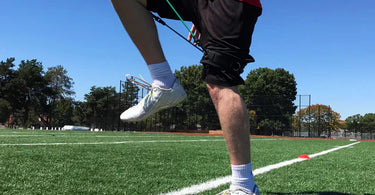
Summer Speed Training: The At-Home Plan to Come Back Faster This Season
Every season is won in the offseason — and for most youth and high-school athletes, the offseason is summer. Summer speed training is the highest-leverage work an athlete can do all year, because it's the one stretch with no games on the calendar and real time to develop acceleration. The catch is that summer is also when structure disappears. Practices thin out, the schedule opens up, and the hours quietly turn into screen time. By August, the athletes who did something with those hours show up a half step ahead of the ones who didn't.
The good news: you don't need a facility, a private coach, or two-a-days. You need a driveway, fifteen to twenty minutes a few times a week, and a plan. Here's how to build one.
Key takeaways
- Summer is the best time to get faster because there's time to develop — not just maintain — acceleration.
- First-step quickness is trainable with short, focused sessions: 3 days a week, 15–20 minutes each.
- The most effective at-home method is resisted-to-unresisted training: run a drill against resistance, then run it free.
- Consistency beats volume — quality reps that look fast, not conditioning that wears the athlete out.
- A plan you'll actually follow is the difference between progress and gear that ends up in the closet.
Why summer is the best time to train speed
During the season, speed work competes with games, travel, recovery, and sport-specific practice. There's rarely time to actually develop acceleration — most in-season training only maintains it. Summer flips that. With games off the calendar, you have an uninterrupted block to work on the one quality that separates athletes at every level: how fast they get moving in the first few steps. First-step quickness and acceleration are trainable, and they respond to consistent, focused work — exactly the kind that's hard to fit in during the season and easy to fit in over the summer.
How do you get faster over the summer? Train resisted, then unresisted
The most effective way to build acceleration at home is the resisted-to-unresisted method, and it's the principle the Kbands leg resistance bands are built around.
Here's the idea. You strap on upper-leg resistance bands — Kbands sit above the knees on adjustable thigh straps, so they move with you through real athletic motion like sprinting, shuffling, and cutting. You run your drill against that resistance, which forces the muscles that drive acceleration — the hip flexors, glutes, and quads — to work harder through the exact movement pattern you use on the field. Then you take the bands off and run the same drill unresisted. The free reps feel lighter and faster, and the nervous system gets to rehearse moving at that higher output.
Resisted reps build the strength and mechanics. Unresisted reps let the body express them. Alternating the two in one session is what makes the work transfer to game speed instead of just making an athlete tired. If you want to understand how Kbands compare to other bands for this, see our breakdown of mini bands vs. hip bands vs. Kbands.
What kind of results can you expect?
In an 8-week test across two Kbands Training camps with athletes ages 7–17, 85% of participants reduced their 40-yard-dash time by 0.2 to 0.5 seconds. Results like that depend on age, training history, effort, and how consistently the work actually gets done — there's no magic in the band itself. The band adds resistance to good training; the training is what produces the result.
A simple summer speed week you can run in the driveway
You don't need to overcomplicate this. Three short sessions a week, 15–20 minutes each, is plenty for a summer block. Here's a template.
Monday — Acceleration
Warm up with a few minutes of light movement. Then, with the bands on: 6–8 resisted first-step starts (explode for 5–10 yards, walk back, reset). Take the bands off and repeat 4–6 unresisted starts, driving the knees and pumping the arms. Finish with a few resisted high-knee marches to reinforce the drive pattern.
Wednesday — Change of direction
With the bands on: resisted lateral shuffles, then resisted 5-10-5 (pro-agility) reps. The resistance makes the athlete load and push off harder out of each cut. Take the bands off and run a few free cuts to feel the difference. This is the session that shows up when an athlete is getting beat to the ball by a half step.
Friday — Acceleration + top speed
Repeat Monday's starts, then add a couple of longer resisted-to-unresisted sprints (15–20 yards) to carry the work into top-end speed. Keep the volume low and the quality high — every rep should look fast.
Rest at least a day between hard sessions, and treat any rep that looks slow or sloppy as the signal to stop. Speed work is about quality, not exhaustion. For more running-based conditioning to pair with this, see our running workout to increase speed and endurance.
What makes at-home speed training actually work
Three things turn a driveway into a real training environment.
A plan you'll actually follow. The reason most "get faster" gadgets end up in the closet is that nobody knows what to do with them after day three. Every Kbands set ships with guided programs — Speed 101 and others — plus access to a library of 1,500+ sport-specific drill videos, so there's always a session to run and a coach demonstrating it. The plan is the product. You can follow a structured progression with the Athlete Performance program.
Drills that feel like your sport. Kids don't want to do "speed and agility." They want to play their sport. The fastest way to keep an athlete consistent all summer is to train speed inside the movements they already love — football route releases, soccer first-step-to-the-ball, basketball defensive slides, baseball and softball breaks. Resistance built into a real sport movement doesn't feel like a chore. (See sport-specific work like our football speed training drills.)
Equipment built for movement. Cheap loop and mini bands are built for slow activation work; they roll, slide, and dig the moment you try to sprint or cut. Kbands use thigh straps and swivel clips designed to stay put through dynamic movement, so the resistance actually stays where it's doing work.
Coaches: the same plan drops into summer camp
If you're running a summer camp or planning fall practices, the same approach scales to a team. A 15-minute resisted block fits into a warmup or a station without rebuilding your practice plan — the same drills your athletes already run, now with resistance. Equipping a group is straightforward too: automatic bulk discounts apply at checkout (10% off $25+, 15% off $200+, 20% off $800+). It's the cheapest way to add real speed development to a whole roster at once. Browse Kbands Training kits and bundles for team setups.
Start this week
The separation you'll see in August is built in the quiet hours of June and July. Pick three days, find fifteen minutes, and run the template above. Strap in, train resisted, finish unresisted, and let the summer do the work.
Ready to build your summer setup? Shop the Kbands leg resistance bands — every set includes the guided programs to run this plan. Coaching a group this summer? See team kits and bulk pricing.
Summer speed training FAQ
How can I get faster over the summer?
Train acceleration 3 days a week in short 15–20 minute sessions using the resisted-to-unresisted method: run first-step starts, lateral shuffles, and short sprints against resistance, then repeat them free. Keep reps high-quality and consistent across June and July, and prioritize sleep and recovery between sessions.
Do resistance bands actually make you faster?
Resistance bands don't make you faster on their own — structured training does. Used correctly, upper-leg resistance bands like Kbands overload the muscles that drive acceleration through real sport movements, and pairing resisted reps with unresisted reps helps that strength transfer to game speed. The included plan is what turns the equipment into results.
How often should a youth athlete train speed?
Two to three focused sessions per week is plenty for most youth and high-school athletes. Sessions should be short (15–20 minutes), high-intent, and spaced with at least a day of rest, because speed is built through quality reps and recovery — not through high-volume conditioning.
How long does it take to get faster?
With consistent training, many athletes notice improvement within several weeks. In an 8-week Kbands Training camp test with athletes ages 7–17, 85% reduced their 40-yard-dash time by 0.2–0.5 seconds. Individual results vary with age, training history, effort, and consistency.
Can you train speed at home without a gym?
Yes. A driveway, yard, or any flat 15–20 yard space is enough for acceleration and change-of-direction work. A portable resistance system plus a guided plan — like Kbands and the included programs — lets an athlete run a complete summer speed session at home with no gym required.
